
Health · Cat Behavior · 4 min read
I've sent more cats to shelters than I can count. Turns out the shelter knew something I didn't.


For years, I met the same cat over and over. Spraying the walls. Fighting the other cat. Hiding all day. The owners had tried everything, and nothing worked. So I told them the same thing. Gently. That their cat would be better off somewhere else.
I've lost count of how many cats I sent to shelters that way. The truth is I was out of answers.
Then I spent a morning at one of the shelters I'd been sending them to.
That whole morning, I kept seeing cats I'd called hopeless. Cats I'd ripped away from owners who loved them. Cats that had sprayed, fought, hissed, and hid in the back of the cage. Now they were calm. It had taken a week or two, the staff said. No drugs. No training. They'd learned something I never had. Something the cats could feel and I couldn't. And nobody outside those walls talks about it.
I stood there feeling sick. Because I finally understood what I'd done. I'd been sending cats away from a loving home for a problem the shelter already knew how to fix.
If a vet, a friend, or a partner has ever hinted your cat might be better off somewhere else, this is the part they skipped. You are not a bad owner. If anyone gave up too early, it was me.
Your cat isn't bad. Your cat is suffering.
Let me take the weight off you first, because you're carrying the wrong one.
You think your cat is doing this on purpose. Peeing on your bed. Spraying the couch. Shredding the sofa. Attacking the other cat out of nowhere. But it isn't.
I had it wrong for twelve years. It took a shelter to set me straight. None of this is your cat being bad.
A cat sprays to make a spot smell like theirs. They scratch the sofa to leave their own mark. They hiss and fight because the other cat feels like a threat. They hide under the bed, or cry at the door for hours, because every sound feels like danger. Six behaviors on the surface. One cause underneath every one. Your cat doesn't feel safe.
Spraying. Scratching. Crying. Hissing. Fighting. Hiding. You think it's six problems. It's almost always one.
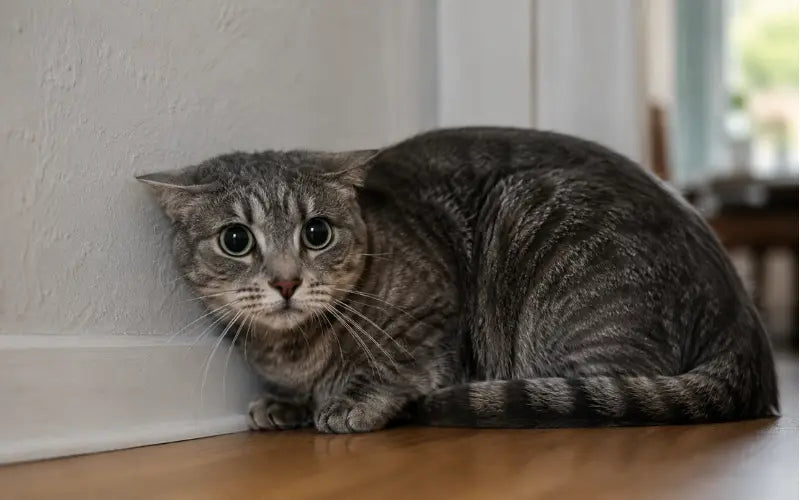
And here's the cruel part. The things we do to stop it do the opposite. The spray bottle. The shout when you find the patch. The door you keep shut. The scolding when they creep back out. To a stressed cat, every one of those is one more thing that isn't safe. So they mark more. Hide more. Lash out more. You punish the problem, and the problem grows. You're both trapped in the same loop, and no one ever showed you the way out.
Your cat has a second nose. You don't.
You've spent months trying to reach your cat. With patience. With love. With a raised voice you probably regretted. None of it landed, because none of it was in a language your cat can read.
Your cat reads one thing. A signal. One you can't hear, see, or smell. It runs through a sense you don't have. A second nose.
It sits in the roof of their mouth, and it doesn't pick up smells. It reads signals that carry no scent at all. Those signals go straight to the one part of the brain that decides whether your cat is safe or in danger.
That's the whole language. Not sound. Not sight. A silent signal, read by an organ we were never born with.
Your cat leaves this signal everywhere. Every time they rub their face on the couch, the doorframe, your leg, they lay down a mark that says one thing. Safe. It's why your cat rubs their face on you. They're not only being affectionate. They're marking you as part of their safe world.
And that was the shelter's secret. No drugs. No training. They were filling the air with a copy of that exact signal. The one that tells a frightened cat, in the only language they have, that this place is safe.
But there was a second signal. And it was the one that finally explained the fighting.
Why two cats who "hate each other" never actually did
For the marking, the shelter used the safe signal. But the fighting ran on a different one. And it comes down to something almost nobody knows about cats.
In the wild, cats don't live with strangers. They live in families. A mother, her sisters, her daughters, all raising kittens together, sharing one scent. Rubbing against each other until every cat in the family smells the same. That shared smell is how a cat knows who's family and who's a threat.
The cats I sent away for fighting were almost never related. Strangers, brought into the same home years apart, with no way to become family.
Here's what I finally understood. To each of them, the other wasn't a housemate. It was an intruder that showed up one day and never left. Sleeping in their spot. Eating from their bowl. A stranger they couldn't chase out and couldn't trust. You wouldn't relax either. You'd defend your ground too.
I called it aggression. It was never hate. Only two cats who never became family.
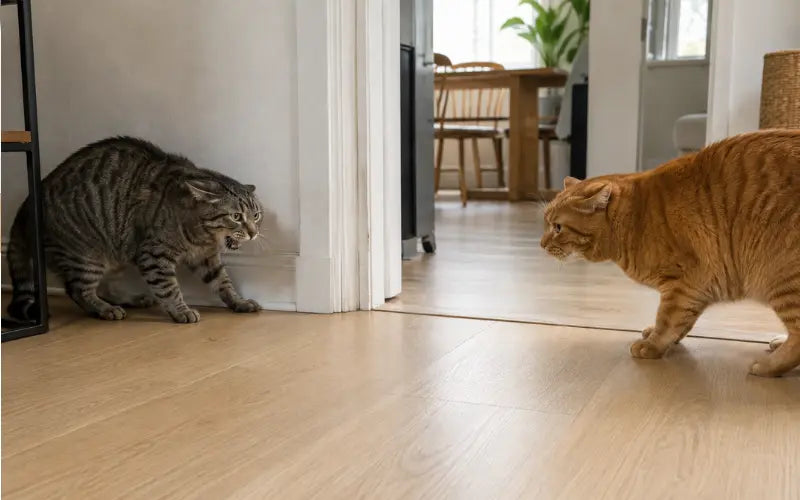
That's why the slow introductions and the "give it time" never quite worked. Time doesn't build a family scent. Only the signal does. It's the second thing a mother passes to her kittens. The one that says: you're one of us, you can stand down.
The shelter had that signal in the air too. Two cats that had spent a week hissing through the bars slowly stopped. Not best friends. But calm. Not because they were drugged. Because for the first time, they smelled like family.
That was the whole secret. Two signals. The safe one, and the family one. Doing in a few weeks what I'd spent twelve years failing to do with advice and good intentions.
So I asked the shelter a question
Those signals calmed cats in cages. In a shelter full of strangers, noise, and fear. The worst place a cat can be. And I couldn't stop thinking about one thing. If it worked there, imagine what it could do at home. With someone who loves them.
The staff smiled. Because that was the part they'd been trying to tell vets like me for a while. You can get the exact same thing for your own home.
It's a small plug-in. You put it in the wall, and it quietly fills the room with both signals. The one that says safe, and the one that says family. No batteries. No routine. You plug it in and walk away.
And here's the part I wish I'd understood twelve years ago. Your cat doesn't have to cooperate.
Think about everything you've already tried. The chews they sniffed and walked away from. A pill no amount of tuna could hide. A collar you found under the couch by morning. Every one of those needed your cat to play along. But a stressed cat's whole personality is refusing to play along.
This asks for nothing. Your cat just has to breathe.
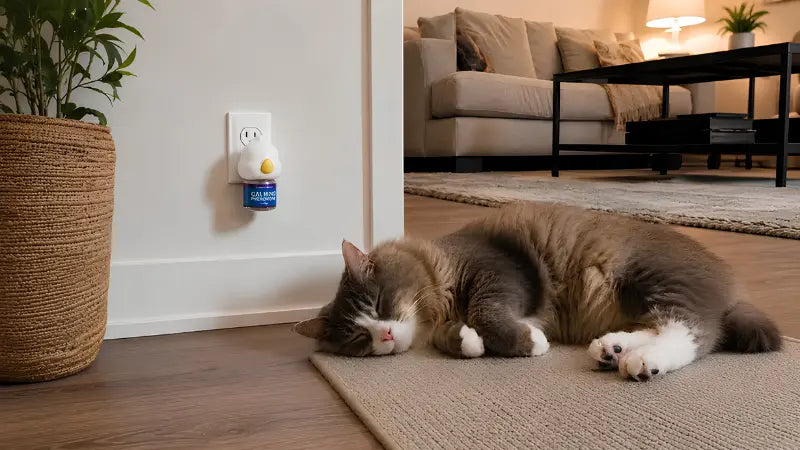
You won't smell a thing either. Only a cat's second nose can read it, which means nobody else in your home is even aware it's there. Not you. Not your dog. Not another pet in the house. No smell isn't a flaw. It's the proof it reaches your cat, and no one else.
It's called Snoots. The same signal the shelter used to bring cats back from hopeless. Except this time, your cat never has to leave home to get it.
What actually happens, week by week
The shelter told me what to watch for. "The first signs show up within days. It's not a switch. It's a slow climb back to calm."
Ever since, I've sent it home with my own clients. And I tell every one of them the same thing.
The first tell
The signs are small. They settle faster. They flinch less. The house starts to feel quieter.
The turn
Fewer marks on the wall. Shorter standoffs. More time out in the open, less time hiding.
You'll know
Most cats have clearly settled by now. And if yours is the rare one that hasn't, one email sorts it out.
Not a switch. A slope. But after months of cleaning, bracing, and giving up, a couple of weeks goes fast.
And you wouldn't be the first to find out. A shelter proved it. Then dozens of my own families did. And more than a hundred thousand homes since.
My two wouldn't share a couch without it turning into a fight. Now I find them folded into each other most afternoons. I still stop and stare every time.
★★★★★ Carlos R., San Antonio
The marking started the day we brought our second cat home. Eight days after plugging this in, it just stopped.
★★★★★ Alyssa N., Charlotte
The signal that did all this is the same one you can plug in tonight.
👉 Check AvailabilityThe cats I can't forget
There's a moment I've lived too many times, and it still guts me.
A family in my exam room. A carrier on the table. Inside, a cat looking out through the bars while the family signed the papers to give them up. Not sick. Not old. Just "too much." Spraying. Fighting. Hiding. A problem I swore was hopeless.
I told them it was the kindest thing. I watched them cry in the parking lot. And I sent a healthy cat away, for a problem I could have fixed with something that plugs into a wall.
I have to carry that. You don't.
Because your cat is still here. Still yours. Still somewhere in your house right now, waiting for it to feel safe again. You found the answer. Those families never had one.
So look at the next month, honestly. Both ways.
Wait, and nothing changes. The same mess to clean. The same door you keep shut. The same knot in your stomach when you get home, wondering what you'll find. And the part nobody says out loud: you start to resent the animal you love. You didn't bring a cat home to manage a problem. You brought one home for company. And every hard day pushes that company a little further away.
Or you put the signal back in the air tonight. And within a week, it starts to turn. Whatever the trouble was, the marking, the fighting, the hiding, it begins to fade. Your cat softens. The house finally breathes.
Your cat was never bad. They were never asking for more love. They were asking to feel safe. And tonight, for the first time, you can give them that. No pill. No fight. Nothing they have to agree to.
Don't spend one more month bracing. Give your cat back the home they never stopped wanting.
30-day money-back guarantee
Snoots supports normal cat stress behaviors and is not a medicine. It does not diagnose or treat any medical condition.